
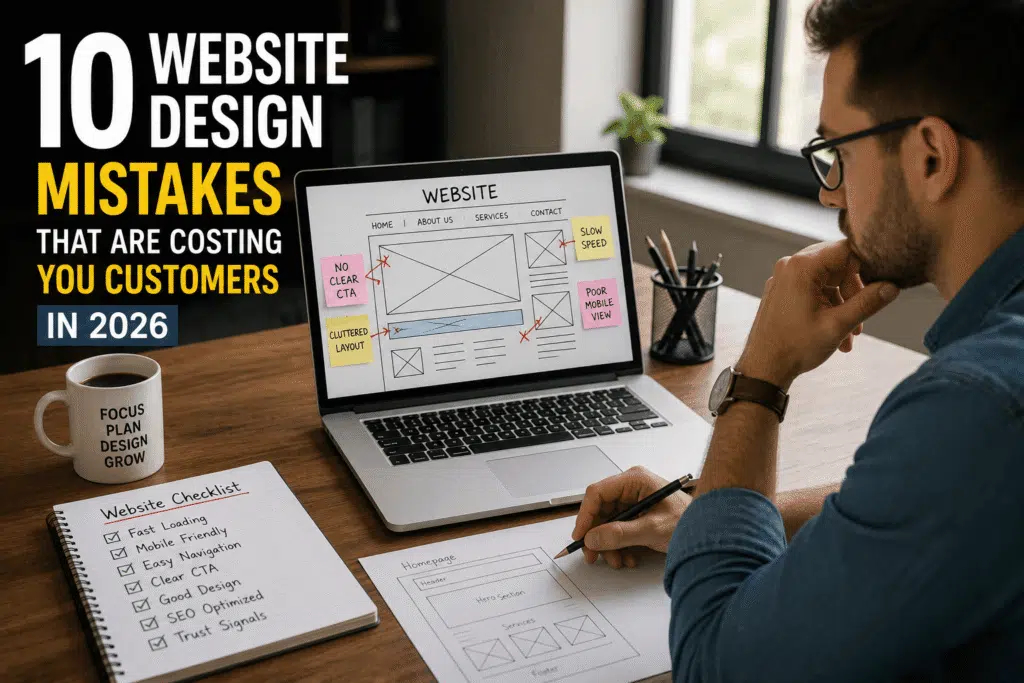
You’re spending money to drive traffic — through Google Ads, SEO, or social campaigns — and the clicks are coming in. But the leads aren’t. If that sounds familiar, the problem usually isn’t your targeting or your budget. It’s the page people land on after they click.
A landing page has one job: convert a visitor into a lead. Not inform them about everything your company does, not win a design award, not impress them with animation. Just get them to fill out a form or pick up the phone. Yet most landing pages we audit are working against that single goal in half a dozen quiet ways.
This guide breaks down the most common landing page mistakes that are silently costing businesses leads, and exactly how to fix each one.
Why Landing Page Mistakes Are So Expensive
Every visitor who lands on your page and leaves without converting is a visitor you already paid for. Whether that click came from SEO services, paid search, or social media, the cost was already spent the moment they clicked. A landing page mistake doesn’t just lose you a lead — it wastes every dirham spent getting that person there in the first place.
This is why landing page optimization is often the single highest-leverage fix in any performance marketing strategy. You can improve targeting and creative all you want, but if the page itself leaks visitors, you’re pouring traffic into a bucket with holes in it.
Mistake 1: Too Many Competing Calls-to-Action
This is the most common mistake we see. A landing page with a “Call Now” button, a “Book a Demo” link, a “Download Brochure” button, and a contact form all on one page isn’t giving visitors options — it’s giving them decision fatigue. When people are unsure what to do next, most of them do nothing.
The fix:
- Pick one primary conversion goal per page (form submission, call, or WhatsApp — not all three treated equally)
- If you must offer a secondary action (like a phone number for urgent needs), make it visually secondary, not competing for the same attention
- Repeat the same CTA button 2–3 times down the page, not different CTAs
A landing page built around a single goal converts significantly better than one trying to capture every possible visitor type at once.
Mistake 2: The Page Doesn’t Match the Ad or Search Intent
If someone clicks an ad for “emergency AC repair Business Bay” and lands on your general homepage with a slider about “all our services,” you’ve already lost them. This mismatch — called message match — is one of the biggest silent killers of conversion rate.
The fix:
- Every campaign or keyword group should have its own dedicated landing page, not a shared generic page
- The headline on the landing page should closely mirror the ad copy or search query
- Keep the same tone, urgency, and specific service language the visitor expected when they clicked
This is exactly the logic behind building condition-specific or service-specific pages rather than sending all traffic to one general page — a pattern that consistently outperforms generic pages in both paid and organic search, and is central to how strong SEO services in Dubai campaigns are structured.
Mistake 3: Slow Load Speed, Especially on Mobile
Most Dubai traffic today is mobile. If your landing page takes more than 2–3 seconds to load on a phone, a meaningful percentage of visitors will leave before they even see your offer. This isn’t a minor technical detail — it’s one of the most measurable, fixable causes of lost leads.
Common causes:
- Unoptimized, oversized images
- Too many third-party scripts (chat widgets, trackers, fonts) loading before the page renders
- Heavy animations or video backgrounds that aren’t lazy-loaded
- Poor hosting or lack of caching
The fix:
- Compress and properly size all images before upload
- Load non-critical scripts asynchronously
- Test speed specifically on mobile using real device testing, not just desktop previews
- Keep hero sections lightweight — a fast, simple hero converts better than a slow, beautiful one
This is a core part of how we approach website design — building pages that are visually strong but engineered first for speed and responsiveness, since speed directly protects the traffic you already paid to acquire.
Mistake 4: Forms That Ask for Too Much
Every additional field on a lead form reduces your conversion rate. Businesses often add fields because internally it feels useful to collect more information upfront — company size, budget range, how they heard about you — but each of those fields is a small reason for the visitor to abandon the form.
The fix:
- Ask only for what’s truly needed to follow up: name, phone number, and maybe one qualifying question
- Move detailed qualifying questions to the follow-up call, not the first form
- If longer forms are unavoidable (e.g., for B2B or higher-ticket services), consider a multi-step form that only shows one or two fields at a time — this feels shorter even when it collects the same data
- Always test form length against conversion rate rather than assuming more fields mean better-qualified leads
Mistake 5: No Trust Signals Above the Fold
Visitors decide within seconds whether a business feels credible. A landing page with no reviews, no certifications, no client logos, and no indication of experience is asking visitors to take a leap of faith — and most won’t.
What to include:
- Star ratings or a Google review count, ideally visible without scrolling
- Years in business or number of customers served
- Recognizable client logos, if you work with known brands
- Relevant certifications or licenses (especially important for healthcare, automotive, or trade services)
- Real photos of your team, location, or work — not generic stock imagery
Trust signals matter even more for service businesses where the customer can’t physically inspect what they’re buying before committing, which is why they’re a non-negotiable element in the landing page templates we build across healthcare, automotive, and real estate clients.
Mistake 6: Weak or Generic Headlines
“Welcome to [Company Name]” or “Quality Services You Can Trust” tells a visitor nothing about why they should care. Most visitors spend only a few seconds scanning a headline before deciding whether to keep reading — a weak one loses them immediately.
The fix:
- Lead with the specific outcome the visitor wants, not your company name
- Be specific: “Same-Day AC Repair in Business Bay” outperforms “Trusted AC Repair Services”
- Address the visitor’s actual search intent directly in the first few words
- Keep it under 10 words where possible — clarity beats cleverness
Strong headline writing borrows directly from good content marketing principles — specificity, clear value, and language that mirrors how customers actually describe their problem.
Mistake 7: Burying the Phone Number or WhatsApp Link
For many service businesses in Dubai, a large share of leads come from phone calls or WhatsApp messages, not form fills — especially for urgent needs like repairs or bookings. Yet many landing pages hide the phone number in a tiny footer link or make WhatsApp an afterthought.
The fix:
- Make click-to-call and WhatsApp buttons visible in the hero section, not just the footer
- Use sticky mobile CTAs (a fixed call/WhatsApp bar at the bottom of the screen) for mobile visitors
- Test click-to-call buttons on an actual phone to confirm they dial correctly
- Include the phone number as text near the CTA, not just as an icon — some visitors prefer to note it down and call later
Mistake 8: Navigation Menus That Let Visitors Escape
A full site navigation bar at the top of a landing page gives visitors an easy way to wander off before converting. Every link away from the page is a potential lost lead, especially on paid campaigns where you’re paying for that visitor’s attention.
The fix:
- Remove or minimize the navigation menu on dedicated landing pages, especially for paid traffic
- If a menu is necessary, limit it to essential links only, not the full site structure
- Keep footer links minimal — legal pages are fine, but don’t link out to unrelated blog posts or services from a conversion-focused page
Mistake 9: No Clear Value Proposition
Visitors need to understand, within seconds, what makes your business the right choice — not just what you offer, but why they should choose you over the next search result. Many landing pages describe services in detail but never actually answer “why us?”
The fix:
- Include 3–4 short value points near the top of the page (e.g., “Same-day service,” “Certified technicians,” “5-star rated,” “Transparent pricing”)
- Use icons or a simple grid layout so these are scannable, not buried in paragraph text
- Back up claims with numbers where possible — “500+ happy customers” is stronger than “many happy customers”
Mistake 10: Ignoring Social Proof Beyond Star Ratings
A star rating tells visitors you’re good; a real testimonial tells them why. Pages that skip written or video testimonials miss a major trust-building opportunity, especially for higher-consideration services like healthcare, real estate, or automotive repair.
The fix:
- Include 2–3 short, specific testimonials rather than generic praise
- Testimonials that mention a specific problem solved are far more persuasive than vague compliments
- If possible, include the customer’s name and a photo — anonymous quotes carry less weight
- Rotate testimonials through a slider if space is limited, but ensure at least one is visible without interaction
Mistake 11: One-Size-Fits-All Pages for Multiple Locations or Services
If your business serves multiple areas or offers multiple distinct services, sending all traffic to one generic page significantly limits both SEO performance and conversion rate. A visitor searching for a service in a specific area wants to see that area mentioned, not a generic city-wide message.
The fix:
- Build separate landing pages per service and, where relevant, per location
- Reference the specific area or condition in the headline, not just the body copy
- Use consistent page structure and design system across all variants so they’re fast to build and maintain, while keeping the content genuinely specific to each page
This location and service-specific structure is one of the most reliable ways to improve both ad Quality Score and organic rankings simultaneously — and it’s a core part of how effective web development in Dubai campaigns are structured for multi-location or multi-service businesses.
Mistake 12: No Urgency or Next-Step Clarity
Even an interested visitor can leave a page and simply forget to come back. Pages without any sense of urgency or clear next step leave conversion on the table, especially for visitors who are ready but not yet decided.
The fix:
- Use honest urgency where it applies — limited appointment slots, seasonal offers, same-day availability
- Make the next step explicit: “Fill the form below and we’ll call you within 15 minutes” is stronger than a bare “Submit”
- Confirm what happens after submission (a thank-you message or immediate WhatsApp redirect) so visitors aren’t left wondering if it worked
A Quick Landing Page Audit Checklist
Before your next campaign goes live, run through this list:
- One primary CTA, repeated, not competing with multiple goals
- Headline matches the ad or search intent exactly
- Page loads in under 3 seconds on mobile
- Form asks for the minimum necessary fields
- Trust signals visible above the fold
- Phone/WhatsApp CTA visible in the hero, not just the footer
- Navigation menu removed or minimized
- Clear, specific value proposition near the top
- At least one real, specific testimonial
- Location/service-specific content, not generic messaging
- Clear statement of what happens after form submission
Frequently Asked Questions
How much can fixing landing page mistakes actually improve conversions?
It varies by starting point, but businesses correcting multiple issues at once — message match, form length, and page speed in particular — commonly see conversion rate improvements in the 30–100% range. Since traffic cost stays the same, this directly lowers cost per lead.
Should every ad campaign have its own landing page?
Ideally yes, especially for distinct services or locations. Sending all campaigns to one shared page dilutes message match and makes it harder to identify which specific offer or audience is converting best.
Is a shorter landing page always better?
Not necessarily. Length should match the consideration level of the decision. A same-day repair service can convert well with a short page, while a higher-ticket B2B service often needs more information, trust-building, and detail before a visitor is ready to convert.
How often should landing pages be tested or updated?
At minimum, review performance monthly and test one major element (headline, CTA, or form length) at a time. Landing pages aren’t a “build once and forget” asset — ongoing testing is what compounds results over time.
Final Thoughts
Most businesses focus their optimization energy on targeting, keywords, and ad spend — and overlook the page that actually has to do the converting. Fixing landing page mistakes is often the fastest, most cost-effective way to lower your cost per lead, because it doesn’t require spending more on traffic. It requires spending your existing traffic more effectively.
If your current pages haven’t been reviewed in a while, it’s worth a proper audit. Get a free consultation and we’ll show you exactly where visitors are dropping off before they convert.